

At a Glance
- Service: Adult Orthodontics with every appliance category: modern metal, ceramic braces, aligners, lingual braces, custom 3D printed brackets
- Serving: Holmdel adults, from the Holmdel Park and Longstreet Farm side to the Route 35 corridor
- New patients: yes; consultations are complimentary
- Key differentiator: recommendations read off your scan data, with five systems available and none of them pushed
The Inputs: What Gets Measured
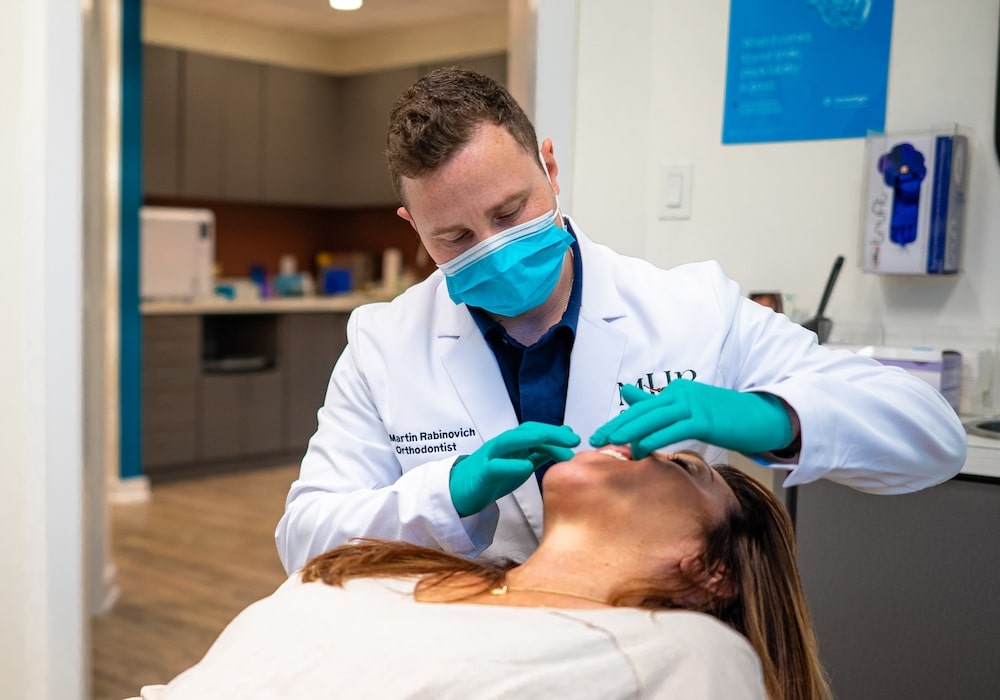
Three datasets decide adult candidacy. First, the digital scan maps every tooth surface and its position to sub-millimeter resolution, quantifying the crowding, spacing, and rotation the treatment would resolve. Second, x-rays read what the scan cannot: root positions, bone levels, and the periodontal foundation that will carry the forces. Third, the clinical exam inventories your dental history, crowns, implants, veneers, prior orthodontics, and current gum status, because adult treatment plans are built around existing infrastructure rather than a blank slate. Dr. Martin Rabinovich, a board-certified orthodontist, reads all three personally, and the classification below falls out of that read.

Yellow Lights: Sequence Something First
Some inputs return a not-yet rather than a no. Active gum disease is the common one: inflamed or unstable periodontal tissue must be treated and settled, coordinated with your general dentist or a periodontist, before orthodontic force applies, usually a matter of months. A planned implant is another sequencing case, and often a favorable one, since orthodontics can open or upright the space so the implant lands correctly; the order of operations gets mapped before either starts. Pending restorative work, a crown or bridge in progress, simply gets scheduled into the plan. Yellow lights delay the start date; they rarely change the outcome.
Red Lights: When the Answer Is No
A minority of consultations end in an honest no, and the reasons are specific. Severe skeletal discrepancies in fully grown adults, where the jaws rather than the teeth are the underlying problem, may need surgical orthodontics or acceptance rather than appliances alone, and that conversation happens plainly. Uncontrolled periodontal disease that cannot be stabilized rules out force application. And misalignment so mild it neither bothers you nor harms anything earns a recommendation to keep your money, which this office delivers without a retention scheme attached. A no here costs the drive and nothing else, and it comes with the reasoning shown on your own scan.
The Appliance Decision Tree
A green light opens a five-branch tree. Complex corrections and reluctant-compliance profiles branch toward fixed appliances: modern metal for efficiency, ceramic clear braces for the same mechanics in tooth-colored hardware, LightForce 3D printed brackets where custom fixed precision earns its place. Mild to moderate cases with disciplined wearers branch toward clear aligners, in Invisalign or Spark systems, covered in depth on the Holmdel clear braces page of this site. Adults requiring absolute invisibility branch to InBrace lingual braces behind the teeth. The tree's deciding variables are the movements your case needs and the visibility you will accept, in that order, and the scan supplies the first while you supply the second.
After a Yes: Timeline and Maintenance Phase
Treatment runs on checkpoints every 8 to 12 weeks, short visits where actual positions get compared against planned ones and corrections fold in early. Expect brief pressure after adjustments or tray changes, a hygiene routine scaled to the appliance, and a working life that continues uninterrupted; Bell Works schedules and city commutes coexist with every option on the menu. Retention follows completion for the long term, custom retainers nightly at first and tapering, because adult bone consolidates over months and the maintenance phase is what makes the output state permanent. Total system uptime, properly retained: decades, which is a maintenance ratio few purchases in your life will match.
Meet Dr. Rabinovich: The Evidence Habit

The classification approach on this page is not a marketing frame; it is how its doctor was trained. Dr. Martin Rabinovich earned his Master of Science in Dentistry at the University of Colorado for clinical research conducted during his residency in Orthodontics and Dentofacial Orthopedics, treating cleft lip and palate and craniofacial patients through the Children's Hospital of Colorado, cases where treatment decisions answer to data or fail visibly. Board certified by the American Board of Orthodontics and raised in Marlboro, he runs a practice where the recommendation is read off the scan in front of you, with the reasoning shown rather than asserted. Holmdel audiences tend to test explanations; his hold up.
Adult Orthodontics
Our Dental Services Include:
Holmdel Adult Orthodontics FAQs
I have been missing a molar for years. Can orthodontics prepare that space for an implant?
A: Often, yes, and this is one of adult orthodontics' most valuable jobs. Neighboring teeth drift into an empty space over time, and treatment can upright them and reopen the correct gap so an implant places properly. The sequencing between orthodontist and implant dentist is mapped before either treatment starts.
I had scaling and root planing for gum issues last year. When am I cleared to start?
A: Once your periodontal status is stable and your dentist or periodontist confirms the tissues have settled, typically demonstrated over a few maintenance visits. Orthodontic force on inflamed tissue risks bone, so the clearance is a real gate rather than a formality. The office coordinates directly with your dental team on timing.
My dentist says aligners cannot fix my deep bite. Is that true?
A: Sometimes, though less often than it used to be. Deep bites involve vertical movements that challenge aligners, and severe versions do better in fixed appliances; milder ones increasingly respond to aligners with attachments and staged planning. The scan classifies which side yours falls on, and this office carries both routes, so the answer is clinical rather than commercial.
Do adults actually finish treatment at better rates than teens?
A: Adult compliance is generally excellent, which is why adult cases track well despite slower bone remodeling. Adults chose and funded the treatment themselves, wear aligners as prescribed, and keep checkpoint schedules. The practical implication: if you are motivated enough to research candidacy, you are likely in the strongest compliance category the office sees.
My Bell Works employer offers a lifestyle spending account. Can it pay toward treatment?
A: Frequently, yes. Employer lifestyle or wellness accounts often reimburse orthodontics, and they stack with dental insurance, FSA or HSA funds, and the office's no-interest monthly plans. Bring your benefit's terms to the consultation and the front desk maps which funding sources apply to your quote.
Got a question? We have answers.
Follow us on social media!
