

At a Glance
- Service: Adult Orthodontics, full appliance menu, every adult decade treated
- Serving: Englishtown and surrounding Manalapan, from the Main Street village to the Lake Weamaconk neighborhoods
- New patients: yes; consultations are complimentary
- Key differentiator: a caseload full of adults who also thought their window had closed
Where the Deadline Myth Comes From
The myth has an honest origin, which is why it survives. Childhood really is the window for one specific job: jaw growth modification, the expander-and-headgear category of work that redirects a still-growing skeleton, has to happen while growth is happening. A generation of parents heard get them in before it's too late, meaning that job, and a generation of kids filed the whole field under expires-at-fourteen. But moving teeth through bone is a different job entirely, and it runs on a biological process, bone remodeling, that continues every year you are alive. The deadline was real for one procedure and got remembered as real for all of them. That misfiling is the entire barrier, and it has kept a generation of Englishtown adults out of a chair they qualified for the whole time.

The Menu at Any Age
Adults who boarded late get the full modern menu, most of which did not exist when the myth formed. Clear aligners, in Invisalign and Spark systems, straighten invisibly and removably, with the aligner route covered in depth on the Englishtown clear braces page of this site. Ceramic clear braces deliver fixed control in tooth-colored hardware. InBrace lingual braces hide fixed treatment entirely behind the teeth. Modern metal remains the efficient pick for complex corrections, in far smaller hardware than the eighth-grade memory, and LightForce 3D printed brackets customize fixed treatment per tooth. Dr. Martin Rabinovich, a board-certified orthodontist, matches system to scan, and the age on the chart changes the pacing math slightly and the eligibility not at all.
Candidacy for the Convinced-It's-Too-Late
The actual gates are the standard adult ones, none of them a birthday. Gums and supporting bone must be stable before force applies, sequenced with your dentist where treatment comes first. Existing dental work becomes planning input: crowns move with their teeth, implants anchor in place, bridges move as units. Severe skeletal discrepancies get the honest conversation about what appliances alone can and cannot do. And drift so mild it bothers nothing earns a keep-your-money, delivered as plainly at sixty as at sixteen. The complimentary consultation runs the whole assessment in one visit, and for most of the convinced-it's-too-late cohort, the scan delivers the anticlimax of a lifetime: you are a routine case, and routine cases start whenever their owners decide to.
What Starting Late Actually Looks Like
The lived experience of late-starting treatment is smaller than decades of avoidance predicted. A digital scan, no impression putty. Checkpoint visits every 8 to 12 weeks, brief, bookable around any schedule including all-Saturday patterns. A day or two of pressure with each adjustment or new tray, at every age the same mild announcement that the biology is working. Cases run roughly 6 to 24 months by complexity and appliance, with adult bone's deliberate pace already priced into the written timeline. Then retention, nightly custom retainers tapering toward maintenance, holds the result for the decades the myth said you did not have. You do, and they photograph well.
Meet Dr. Rabinovich: Living Proof Against the Deadline

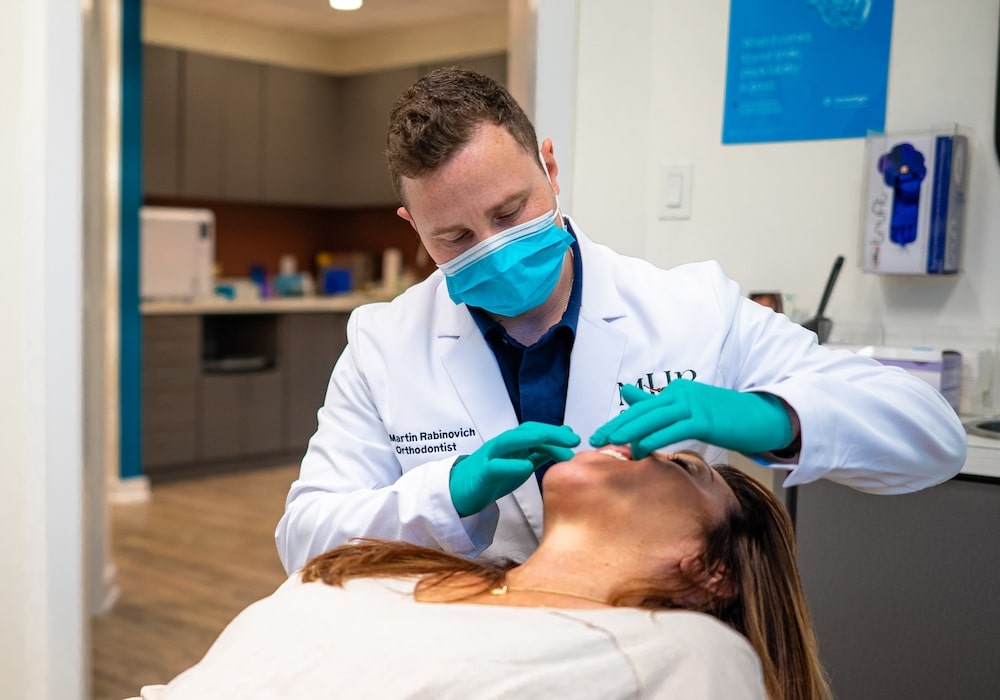
The best evidence against the myth is a specialist's appointment book. Dr. Martin Rabinovich, board certified by the American Board of Orthodontics, Rutgers-trained, and residency-finished at the University of Colorado with a research Master of Science in Dentistry, treats first-time orthodontic patients across every adult decade, and late starters are a daily normal in his Shrewsbury chairs rather than a curiosity. Raised in Marlboro one township east, he built a practice on the golden rule his team recites, and its application here is specific: nobody gets told a comfortable myth when the clinical truth is better news. The truth, for the Englishtown adult who filed this away in eighth grade: your file was wrong, and the correction is free to hear.
Adult Orthodontics
Our Dental Services Include:
Englishtown Adult Orthodontics FAQs
My dentist has never once suggested orthodontics. Does that mean I do not need it, or that it is too late?
A: Neither, usually. General dentists focus visits on the problems in front of them, decay, gums, restorations, and many simply do not raise alignment unless asked, especially with adult patients. Silence is not a clinical verdict. If your teeth bother you, ask directly or book the complimentary consultation here; the scan gives you the actual answer.
Everyone I knew got braces in middle school. Is there not a biological window that closed?
A: There was a window, but for a different job. Childhood is the window for guiding jaw growth, which is why kids get expanders. Moving teeth through bone is a separate process that continues for life, so alignment work has no expiration. The middle-school rush was about growth timing and orthodontic tradition, not about your last chance.
I have lived with these teeth for fifty years. Will a corrected bite feel strange?
A: Briefly, then better. A changed bite feels novel for a few weeks as muscles and habits recalibrate, similar to adjusting to new glasses, and most adults report the corrected position quickly feels like the way teeth were supposed to meet all along. The adaptation is part of every case plan, not a surprise appended to it.
How do I know this is genuinely worth pursuing and not a midlife itch?
A: Let the scan arbitrate. The consultation separates the functional case, plaque traps, uneven bite wear, gum strain, from the purely cosmetic one, and prices each honestly, including the recommendation to skip treatment when nothing needs fixing. A midlife itch dissolves under data; a legitimate case survives it. Either answer costs you nothing to hear.
Could an entire case run on Saturday appointments only?
A: For most adult cases, yes. Checkpoints fall every 8 to 12 weeks, so a full treatment needs a limited number of visits, and the front desk can hold a standing Saturday pattern from the consultation forward. Confirm current Saturday scheduling when you book, and the whole project can leave your workweek untouched.
Got a question? We have answers.
Follow us on social media!
