

At a Glance
- Service: Adult Orthodontics, full menu with an emphasis on the options nobody notices
- Serving: Little Silver adults, from the train station neighborhoods to the Parker Homestead side
- New patients: yes; consultations are complimentary and obligation-free
- Key differentiator: a practice as low-key as its most private patients need it to be
Why Small-Town Visibility Feels Like a Barrier
The math of a small borough amplifies self-consciousness. In a city, a stranger's glance costs nothing; here, every observer has a name, a kid in your kid's class, and a next encounter already on the calendar. Adults picture the compounding: the platform regulars clocking a change, the school-run parents mentioning it, the slow accumulation of a town quietly aware you are fixing your teeth at forty-six. The picture feels realistic because small towns do notice things. What the picture gets wrong is what they are capable of noticing, which is where the audit below earns its place.

The Invisible-Enough Menu
The full adult menu is available, tiered here by detectability. Zero visibility: InBrace lingual braces, fixed control hidden completely behind the teeth. Near-zero: clear aligners in Invisalign and Spark systems, removable, with the aligner route covered in depth on the Little Silver clear braces page of this site. Low: ceramic clear braces, fixed mechanics in tooth-colored hardware. Standard: modern metal, still the efficient pick for complex corrections, chosen by adults whose privacy calculus differs. LightForce 3D printed brackets round out the fixed options in ceramic-toned custom hardware. Dr. Martin Rabinovich, a board-certified orthodontist, matches system to scan first and to visibility preference second, and in this borough the second criterion gets genuine weight.
The Quietest First Step
Activation energy, not information, is what stalls most Little Silver adults, so here is the lowest-commitment version of starting. The consultation is complimentary, books with a single call or an online request, and obligates you to nothing: a conversation, a digital scan, x-rays, and a written plan with exact pricing that goes home with you. No follow-up pressure campaign, no announcement to anyone, no decision required in the room. The visit itself is private by default, five minutes from the borough and outside it, and plenty of patients take the written plan home, sit with it for a season, and start when they are ready. The plan does not expire the way resolve does; get it on paper while the resolve is present.
Candidacy, Privately Assessed
The clinical half is standard adult candidacy. Mild to moderate crowding, spacing, and decades-old drift treat routinely; crowns and veneers move with their teeth; implants stand fixed and get planned around; stable gums are the prerequisite, sequenced with your dentist where needed. Severe rotations and major bite work steer toward the fixed end of the menu. The borough-specific half is behavioral honesty: the option you will actually live with beats the theoretically ideal one, and a patient who would resent visible hardware for eighteen months should say so at the consultation and hear the invisible alternatives priced plainly. Both halves get settled in one free visit, and nobody in town receives the minutes.
Months In, Nobody the Wiser
Treatment in progress asks little and announces less. Checkpoint visits run every 8 to 12 weeks, five minutes away, brief enough to disappear into an ordinary errand window. Tray changes and adjustments bring a day or two of pressure that shows on no one's face. Cases finish in roughly 6 to 24 months by complexity and appliance, and retention follows privately: custom retainers worn at night, tapering over time, doing their work while the town sleeps. The public phase of the entire project is the result, which is the only part you ever wanted an audience for anyway.
Meet Dr. Rabinovich: Low-Key by Temperament

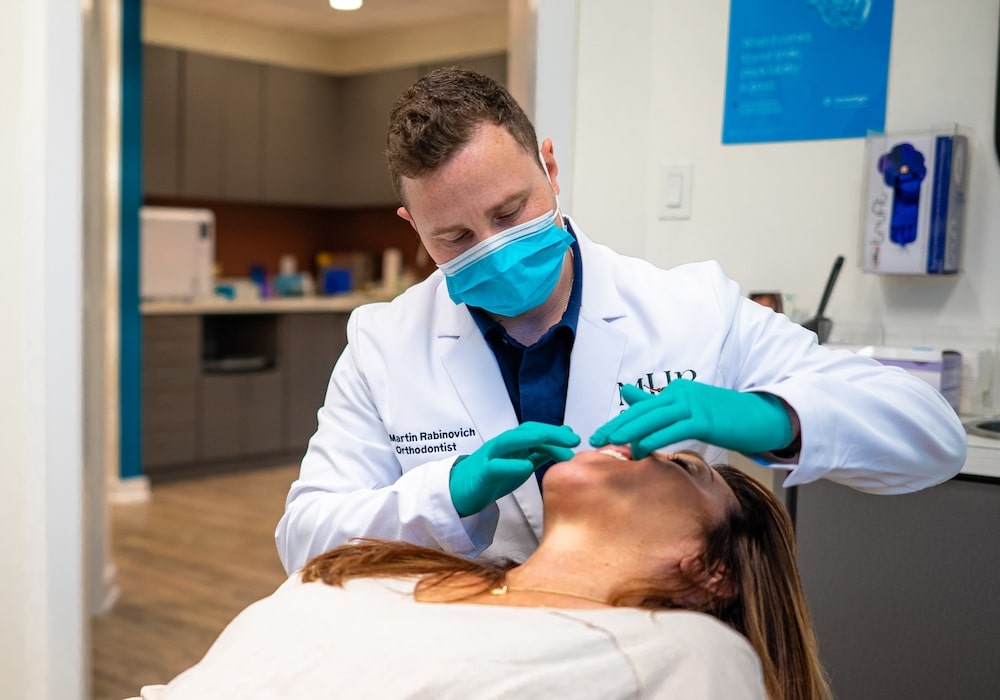
Some practices perform their work; this one just does it. Dr. Martin Rabinovich, board certified by the American Board of Orthodontics, trained at Rutgers School of Dental Medicine and completed his residency in Orthodontics and Dentofacial Orthopedics at the University of Colorado, with a research Master of Science in Dentistry and cleft and craniofacial casework through the Children's Hospital of Colorado. Raised in Marlboro, he runs a quiet, single-specialist office where the operating rule is the golden one his team repeats: treat every patient the way you would want your own family treated. In practice that means unhurried consultations, plain answers, and a complete absence of theater, which suits a borough that prefers its business handled well and mentioned never.
Adult Orthodontics
Our Dental Services Include:
Little Silver Adult Orthodontics FAQs
In a town this small, will people at the market and the train platform be able to tell I am in treatment?
A: With aligners or lingual braces, no; both are undetectable at conversational distance, and lingual hardware is invisible at any distance. Ceramic braces read as subtle rather than hidden. What small towns reliably notice is the finished result months later, usually voiced as you look great without anyone identifying why.
Is it awkward being treated at the same office as families we know from school?
A: Less than you would think, and the logistics help. Visits are brief and infrequent, every 8 to 12 weeks, so overlap with familiar faces is rare, and the front desk can schedule your slots at quieter times on request. Patient privacy is absolute regardless: nobody at this office discusses who is treated here, with anyone.
I keep almost booking and stopping. What is the lowest-commitment first step?
A: Request the complimentary consultation and treat it as information-gathering, because that is all it is: a scan, an exam, and a written plan with exact pricing, no decision required and no follow-up pressure. Many patients sit with the written plan for weeks before starting. The step costs an hour and commits you to nothing.
Can adults book appointments outside the after-school teen rush?
A: Yes. Morning and midday slots run quieter, and the front desk deliberately places adult patients who prefer privacy into those windows. Mention the preference when scheduling and it carries across your whole treatment rather than needing to be re-requested each visit.
I booked a consultation years ago and backed out. Is it strange to come back?
A: Not remotely, and you would have company; returning after a false start is one of the most common adult-patient stories in the practice. Nobody revisits the history or asks for an explanation. Your records simply get refreshed with a current scan, and the conversation starts from where your teeth are today.
Got a question? We have answers.
Follow us on social media!
