

At a Glance
- Service: Adult Orthodontics, full appliance menu from modern metal to lingual braces
- Serving: Marlboro Township adults, from the Route 9 and Union Hill corridor to the township center
- New patients: yes; consultations are complimentary
- Key differentiator: a board-certified specialist treating the Marlboro generation he grew up in
The Cohort Question: Your Generation in the Chair
Start with the fact that resets expectations: the adult in the orthodontic chair today is most typically in their thirties, forties, or fifties, not a twenty-something outlier. Adults approach half of orthodontic patients nationally, and in a family township like Marlboro the pattern compounds, because parents watching their kids' treatments keep concluding that their own turn is overdue. The generation that grew up here in the eighties and nineties is precisely the demographic bulge now filling adult caseloads, which means the question was never do people your age do this. People your age are the market.

The Relapse Contingent
The other half of the cohort did have braces, wore the retainer until college misplaced it, and has watched the lower front teeth quietly recrowd ever since. Relapse candidacy is the friendliest category in adult orthodontics: teeth retracing a known path often correct in shorter treatments with smaller fees, sometimes in months, and the appliance menu opens fully once gums check out. The candidacy question for this group is rarely eligibility; it is scope, meaning how much of the original correction drifted and what it takes to restore it. A scan answers that in one visit, and the answer is frequently better news than twenty years of mirror audits predicted.
What Age Actually Changes, and What It Does Not
Age never disqualifies; teeth move through healthy bone at any birthday. What age changes is the checklist around the movement. Periodontal status becomes the true gate: gums and supporting bone must be stable before force applies, coordinated with your dentist where treatment is needed first. Dental history becomes a planning input: crowns move like natural teeth, veneers travel with their teeth, bridges move as connected units with real limits, and implants stand fixed as planning landmarks. Life stage raises its own questions, pregnancy among them, that get answered case by case at the consultation. None of these are refusals. They are the adult version of the intake form, and most of the cohort clears it.
The Green-Light Checklist
Condensed to a card: you are likely a candidate if your concern is crowding, spacing, or drift in the mild to moderate range, your gums are healthy or treatable to stable, and you can honor the wear and appointment rhythm of whichever appliance fits. You should sequence first if periodontal work or planned restorations are pending. You should redirect to fixed appliances if the case involves severe rotations or major bite correction, which the same office provides. And you should keep your money if the misalignment neither bothers you nor harms anything, a verdict this practice hands out for free and in writing when the scan supports it.
Options Once You Qualify
A green light opens the full menu: modern metal for efficient complex work, ceramic clear braces for fixed control in quiet hardware, Invisalign and Spark clear aligners for removable near-invisibility, covered in depth on the Marlboro clear braces page of this site, InBrace lingual braces for zero outward visibility, and LightForce 3D printed brackets where custom fixed precision earns its place. Dr. Rabinovich matches appliance to scan, and the Route 9 commuter, the township-center parent, and the first-timer at forty-five frequently leave with different recommendations for the same reason: the case picked, not the catalog.
The Calendar from Yes to Retainers
A qualified case runs a predictable arc. Records and planning first, then active treatment of roughly 6 to 24 months by complexity and appliance, with checkpoint visits every 8 to 12 weeks that a Marlboro schedule absorbs without noticing. Pressure after adjustments or tray changes fades within days. Retention closes the loop permanently: custom retainers nightly at first and tapering, the discipline the nineties never properly taught, which is why half this cohort exists as relapse cases. The second time through, or the first time done right, the retention habit is the difference between a result and a phase.
Meet Dr. Rabinovich: One of Yours

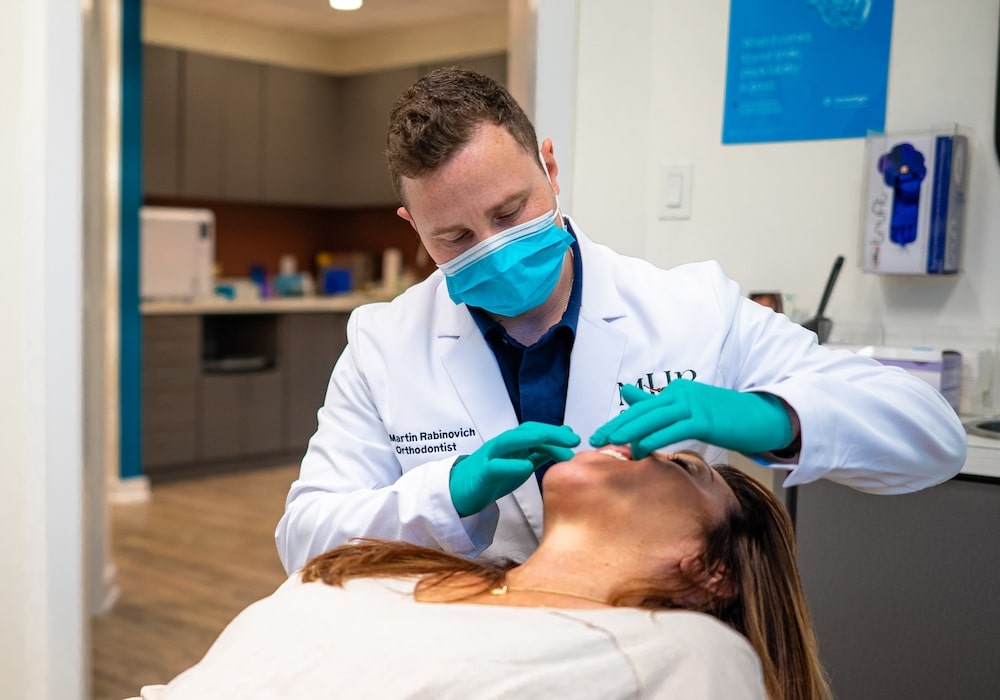
The specialist auditing this cohort's candidacy belongs to it. Dr. Martin Rabinovich was born and raised in Marlboro, came up through the same township institutions as the adults reading this page, and returned after Rutgers School of Dental Medicine and a University of Colorado residency in Orthodontics and Dentofacial Orthopedics, research Master of Science in Dentistry included, to practice twenty minutes from home. Board certified by the American Board of Orthodontics, he treats the parents of his teen patients and, increasingly, the classmates of his own generation, whose nineties-era orthodontic history he understands from the inside. Candidacy conversations go easier with someone who remembers exactly why your family did or did not do braces the first time.
Adult Orthodontics
Our Dental Services Include:
Marlboro Adult Orthodontics FAQs
Is mid-forties actually a normal age to be in your chairs, or am I the outlier?
A: Normal to the point of typical. Adults are a substantial share of the practice's caseload, mirroring the national picture where adults approach half of orthodontic patients, and the thirty-five-to-fifty-five band is heavily represented, Marlboro parents especially. The outlier in today's waiting room is the stereotype, not you.
I never had braces as a kid because my family could not afford them. Is starting from scratch at forty-five harder?
A: Somewhat slower, not harder. Untreated adult cases use the same appliances and finish to the same standard; mature bone simply remodels more deliberately, so timelines run modestly longer and the written quote reflects it. Plenty of first-timer cases also turn out simpler than decades of worry predicted, and the scan settles which kind yours is.
Can I start orthodontic treatment while pregnant?
A: Often, with sensible adjustments. Tooth movement itself is generally compatible with pregnancy, and the office can defer routine x-rays or time records around your trimesters in coordination with your OB. Pregnancy gingivitis is the practical consideration, since gum inflammation affects treatment, so timing gets planned case by case. Raise it at the consultation and the plan works around your calendar.
I have a permanent bridge across three teeth. Does that block treatment?
A: It constrains rather than blocks. A bridge moves as a single connected unit, so the plan treats it as one large tooth with limited movement options, adjusting the surrounding teeth around it. Some cases achieve full correction with the bridge in place; others involve your dentist in a sequence. The scan shows which applies before anything is committed.
My weeks alternate between Route 9 commuting and home days with no fixed routine. Does that affect which appliance I should choose?
A: It should influence it, yes. Aligners reward consistent daily rhythms because wear hours are the treatment; irregular weeks make trays easier to neglect. Fixed options, from ceramic braces to lingual, remove the discipline variable entirely and suit variable schedules well. The consultation weighs your honest routine, not your aspirational one, before recommending.
Got a question? We have answers.
Follow us on social media!
