

At a Glance
- Service: Adult Orthodontics, covering the full appliance menu: modern metal braces, ceramic clear braces, Invisalign and Spark aligners, InBrace lingual braces, and LightForce custom braces
- Serving: adults across Monmouth County, from the Bayshore to the river boroughs and the western townships
- New patients: yes; adult consultations are complimentary
- Key differentiator: every appliance category for adults available in one office, matched to the case by a board-certified orthodontist
Adults Are Now Half the Story
Two things ended the teens-only era of braces. The first is appliance technology: treatment no longer requires announcing itself, so the professional and social costs that kept adults away have mostly evaporated. The second is medical understanding: dentistry now treats alignment as an oral-health variable rather than a vanity line item, because crowded teeth trap plaque, misdirected bites wear enamel unevenly, and poorly positioned teeth contribute to bone loss over decades. Adults treat because the health case got stronger while the visibility cost collapsed. The result is a patient population where the person in the chair is as likely to be 48 as 14.

Why Adults Treat: Health First, Cosmetics Second
The cosmetic payoff is obvious, so consider the quieter ledger. Correctly aligned teeth are easier to clean, which lowers the plaque load that drives gum disease and decay. Balanced bites distribute chewing force across teeth built to carry it, protecting enamel and the jaw muscles from decades of uneven strain. Proper tooth position supports the bone that holds your teeth, and improperly positioned teeth contribute to bone loss you cannot feel happening. Chewing itself improves when opposing teeth actually meet. For adults, straightening is dental infrastructure work with a cosmetic dividend, and the earlier it happens, the longer the dividend compounds.
What Adult Treatment Costs in Monmouth County
Fees follow case complexity, appliance choice, and duration, quoted in writing at a complimentary consultation. The adult-specific wrinkle is insurance: some dental plans cap their orthodontic benefit at a dependent age limit, often 19, while many others cover adults under a lifetime maximum. Reading your specific plan is the first financial step, and the front desk does it before quoting, so nobody counts on a benefit their plan reserved for teenagers. The office participates in-network with most PPO plans, accepts FSA and HSA funds, and runs no-interest monthly payment plans that carry whatever remains. Adults who assume treatment is out of reach are usually pricing a memory rather than a quote.
Adult Candidacy in One Honest Paragraph
Age does not disqualify anyone; teeth move through healthy bone at 70 as surely as at 17. What adult candidacy actually turns on is periodontal health, since gums and supporting bone must be stable before force gets applied, and existing dental work, since crowns move like natural teeth while implants stand fixed and get planned around. Adults with active gum disease treat that first, coordinated with their general dentist. Beyond that, the case type steers the appliance rather than the eligibility: complex corrections lean toward fixed options, mild to moderate cases open the whole menu. The scan at a complimentary consultation settles your version of this paragraph in about an hour.
The Adult Timeline, Start to Retention
Adult treatment runs a familiar arc with adult pacing. Digital scans, photos, and x-rays open the case; Dr. Rabinovich engineers the movement plan; the chosen appliance executes it over roughly 6 to 24 months depending on complexity and system, with checkpoint visits every 8 to 12 weeks. Adult bone remodels more deliberately than teenage bone, so some cases run modestly longer than their teen equivalents, a difference the written timeline accounts for up front. Retention follows for the long term: custom retainers, worn nightly at first and tapering, protect an investment adult patients tend to guard well, having waited this long to make it.
Meet Dr. Rabinovich: An Adult's Orthodontist

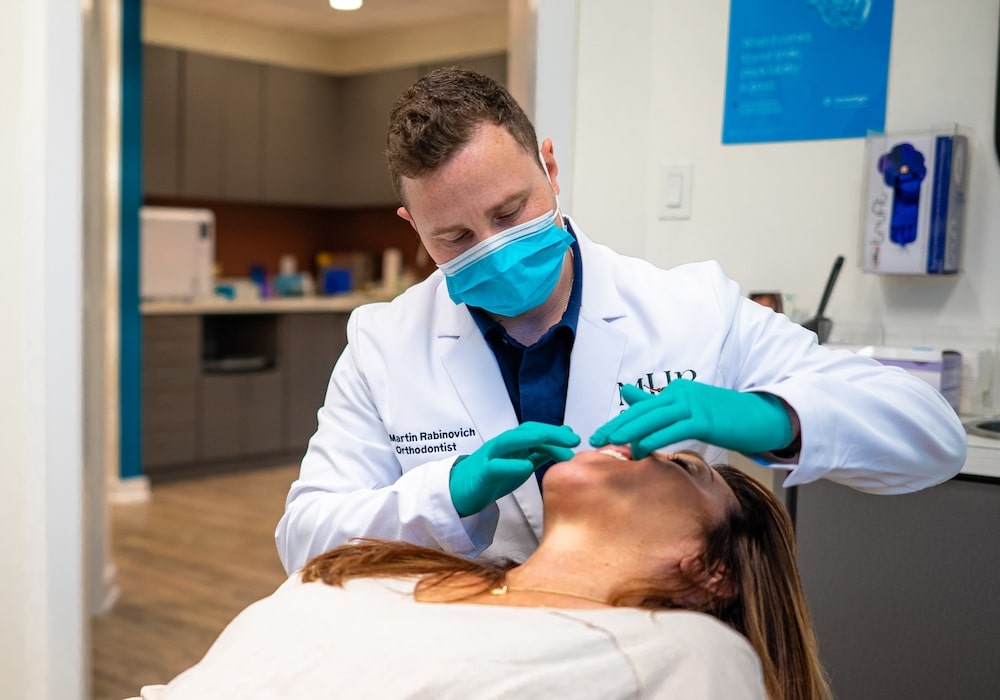
Adult patients tend to research their specialist the way they research a surgeon, so the record is presented accordingly. Dr. Martin Rabinovich holds board certification from the American Board of Orthodontics, the voluntary examination credential earned by only a fraction of practitioners. He trained at Rutgers School of Dental Medicine, completed his specialty residency in Orthodontics and Dentofacial Orthopedics at the University of Colorado with a research-based Master of Science in Dentistry, and maintains active membership in the American Association of Orthodontists, the American Dental Association, the New Jersey Dental Association, and the Monmouth Ocean County Dental Society. Raised in Marlboro, he built his practice in the county that raised him, and a substantial share of his caseload is adults, many of them parents of his teen patients who watched the work up close before booking their own chair.
Adult Orthodontics
Our Dental Services Include:
Adult Orthodontics FAQs for Monmouth County
What share of your patients are adults?
A: A substantial and growing share, consistent with the national picture in which adults approach half of orthodontic patients. Adult treatment is a core part of the practice rather than a sideline, and the appliance menu, scheduling, and financial options are all built with adult patients in mind.
Is treating an adult clinically different from treating a teenager?
A: The mechanics are the same, but the biology and the planning differ. Adult bone remodels more slowly, so movements are paced accordingly, and adult mouths bring history: restorations, wear patterns, and periodontal considerations that the treatment plan works with rather than around. Adult compliance, on the other hand, is typically excellent, which offsets the slower biology.
Do adults need different appliances than teens get?
A: No, adults choose from the same modern systems, and the menu is wider than most adults expect: modern metal, ceramic clear braces, two aligner brands, lingual braces behind the teeth, and 3D printed custom brackets. What differs is the matching: adult cases and adult visibility preferences steer the choice, and the scan makes the final call.
Can orthodontic treatment help with jaw strain or discomfort?
A: Sometimes. When a misaligned bite forces jaw muscles to work unevenly, correcting the alignment can reduce that strain. Jaw symptoms have many causes, though, so the consultation evaluates your bite honestly and tells you what alignment can and cannot be expected to improve rather than promising relief.
My dental plan mentions an age limit on orthodontic benefits. Am I out of luck?
A: Not necessarily. Age caps apply to some plans and not others, and adults are often covered under a lifetime orthodontic maximum, sometimes through a spouse's plan when their own excludes adults. Bring your plan details to the complimentary consultation and the front desk reads the actual language before you assume anything.
Got a question? We have answers.
Follow us on social media!
