

At a Glance
- Service: Adult Orthodontics with the county's deepest bench of low-visibility systems, explained mechanically
- Serving: Rumson adults, from the Ridge Road spine to the river neighborhoods
- New patients: yes; consultations are complimentary
- Key differentiator: discreet appliances chosen on their mechanics, by a specialist certified across all of them
The Problem Statement: Force Without Visibility
Orthodontic movement is applied physics: sustained gentle force on a tooth signals the surrounding bone to remodel, resorbing ahead of the movement and rebuilding behind it. Traditional braces solve the force-delivery problem in plain sight, with brackets as handles and wires as the force source. The discreet systems solve the same problem under three different constraints: deliver the force from behind the teeth, deliver it through a transparent removable shell, or deliver it through hardware engineered to vanish against enamel. Each constraint produces a different machine with different strengths, which is why a serious practice carries all three rather than campaigning for one.

The Attachment System: Aligners' Hidden Hardware
Clear aligners look like passive shells and are anything but. The trays, offered here in Invisalign and Spark systems, deliver force through precisely calculated misfits: each tray is shaped for a tooth position slightly ahead of reality, and the plastic's spring-back supplies the pressure. For movements a smooth shell cannot grip, rotations, extrusions, root torque, the system adds attachments: small composite shapes bonded to strategic teeth, tooth-colored, functioning as handles the tray pushes against. Attachment geometry is engineered per movement, placed per plan, and polished off cleanly at the finish. The aligner route is covered fully on the Rumson clear braces page of this site; the engineering point here is that the invisible option is a genuine force system, not a hopeful mouthguard.
Digital Fabrication: Appliances Built from Your Scan
Every discreet system in the office begins as data. A digital intraoral scan maps your teeth to sub-millimeter resolution; Dr. Martin Rabinovich engineers the movement plan on that model, sequencing which teeth move, in which order, with how much force; and the plan drives fabrication. Spark and Invisalign print your tray series from it. InBrace fabricates custom lingual hardware from it. LightForce 3D prints ceramic-toned brackets shaped to your individual teeth from it, replacing the one-size bracket era with per-tooth geometry. The pattern across all four: the appliance is the output of the plan, and the plan is the product. Rumson patients comparing offices should ask who engineers that plan; here the answer is a board-certified specialist, personally, every case.
Speed Parity: Why Discreet No Longer Means Slower
The old tradeoff, invisibility for time, has mostly closed. Discreet systems now run typical adult cases in the same 6 to 24 month envelope as conventional braces of equal complexity, because the force physics are equivalent and the digital planning is often tighter. What still governs speed is the case itself, complexity and biology, and the patient: removable trays only work while worn, which is the one variable engineering cannot solve. Where a case genuinely finishes faster in fixed hardware, that appears in the written timeline at the consultation, and the choice between two honest timelines is yours to make with the tradeoffs visible.
Who Each Engineering Solution Fits
Candidacy maps onto mechanics. Lingual systems fit adults who need fixed-appliance control, or fail the wear-discipline test honestly, and require zero visibility. Aligners fit mild to moderate crowding, spacing, and relapse in adults with consistent routines. Ceramic braces and LightForce fit cases needing fixed mechanics where near-invisible suffices. The prerequisites hold across all three: stable gums before force, restorations planned around, implants as fixed landmarks. The scan disqualifies options before preference votes, and what remains is usually a two-machine shortlist your priorities settle. A free consultation runs the whole selection live.
Operating Conditions and Maintenance
Whichever machine you commission, the service schedule matches a Rumson calendar: checkpoints every 8 to 12 weeks, brief, with morning slots running against the shore traffic and Saturdays available. Expect a few days of pressure after adjustments or new trays, a hygiene routine scaled to the appliance, and no emergency wire culture; modern systems fail rarely and quietly. Retention closes every case: custom retainers nightly at first, tapering, holding the result while adult bone consolidates. The machinery retires; the output is permanent, and it is the only component that was ever meant to show.
Meet Dr. Rabinovich: Fluent in Every System

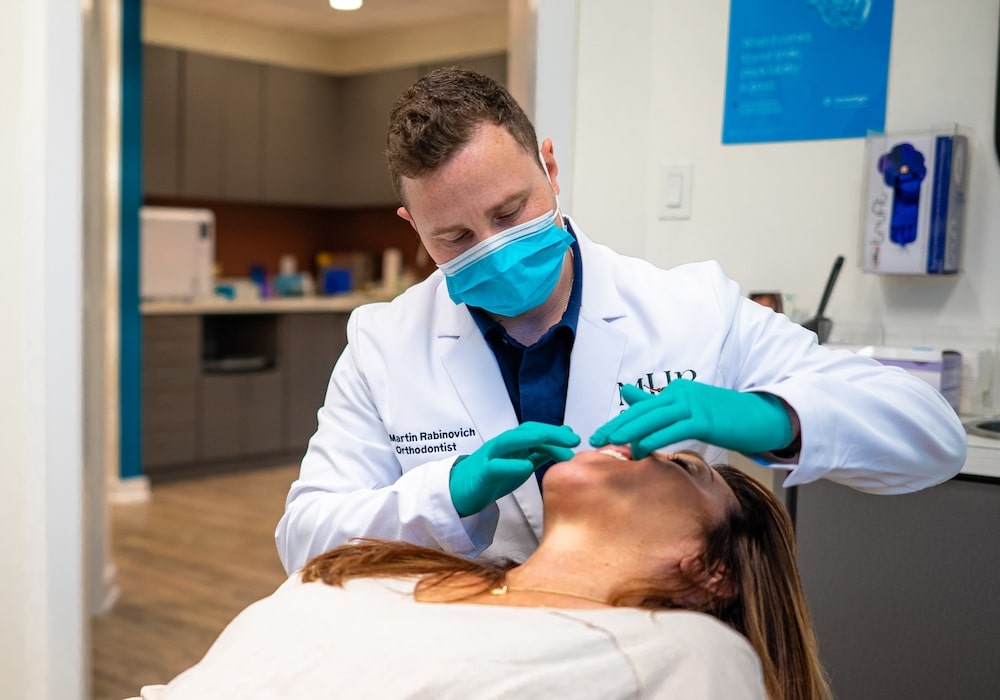
Carrying three discreet force systems requires three certifications and three planning fluencies, and that breadth is deliberate. Dr. Martin Rabinovich is board certified by the American Board of Orthodontics and certified across Spark, Invisalign, InBrace, and LightForce, with conventional braces as the baseline craft. His Master of Science in Dentistry, earned for clinical research during his University of Colorado residency in Orthodontics and Dentofacial Orthopedics, trained the habit this page reflects: understand the mechanism, then prescribe. Raised in Marlboro and practicing in Shrewsbury, he treats the county's most mechanically curious patients with the explanations they actually want, which in Rumson is frequently the deciding differentiator.
Adult Orthodontics
Our Dental Services Include:
Rumson Adult Orthodontics FAQs
How do braces behind the teeth actually move them? Is it as effective as front braces?
A: The force physics are identical; only the delivery side changes. Lingual brackets and wires apply the same sustained pressure from the tongue side, custom-fabricated to each tooth's inner surface, and the system handles rotations and vertical movements that challenge removable trays. For appropriate cases, outcomes match front-side braces, invisibly.
What are aligner attachments made of, and do they come off cleanly at the end?
A: They are small shapes of tooth-colored dental composite, the same material family as white fillings, bonded to the enamel surface to give trays mechanical grip. At the end of treatment they are polished off completely in minutes, leaving the enamel as it was. Nothing about them is permanent except the movements they made possible.
Does choosing a discreet appliance mean accepting a slower treatment?
A: Not anymore, for most cases. Discreet systems run typical adult cases on the same timeline as conventional braces of equal complexity, because the underlying force physics are equivalent and digital planning keeps them efficient. Where a specific case genuinely finishes faster in one system, your written timeline says so and the choice stays yours.
How is a custom appliance like InBrace or LightForce actually made for my teeth?
A: From your scan. A digital model of your teeth drives the fabrication: InBrace builds lingual hardware shaped to each tooth's inner surface with a pre-formed smart archwire, and LightForce 3D prints ceramic-toned brackets matched to each tooth's geometry. The appliance arrives as a manufactured output of your specific treatment plan.
Between sailing season and the school year, is there a smart month to start treatment?
A: If the brief adaptation phase concerns you, aim the start at a quiet stretch of your calendar, late fall and winter suit most Rumson schedules, so the first weeks of a new appliance land before the social season does. Mechanically any month works; the timing question is entirely about your comfort, and the consultation can plan the start date around your year.
Got a question? We have answers.
Follow us on social media!
